In my
previous post, I discussed in general how we get access to electricity. In this post, we will look more closely into the generation sub-sector, one of the three (now four, under Retail Competition and Open Access regime, which we will discuss in a later post) entity types in our electric power industry.
 |
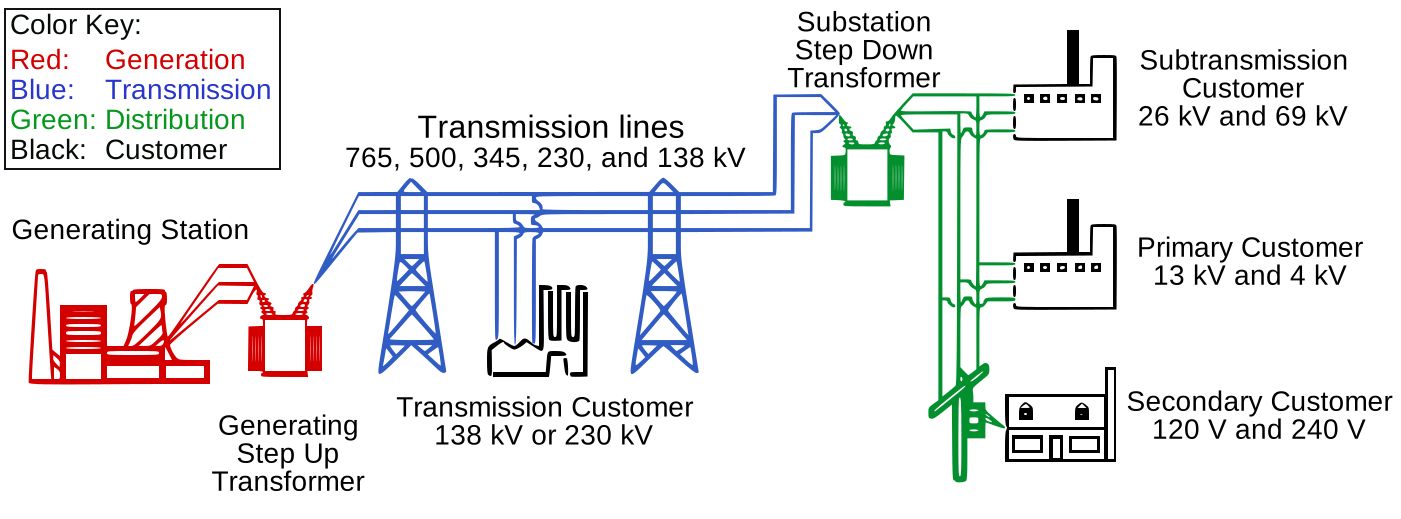
| A general schematic of power generation, transmission and distribution, in the United States, which is generally similar to the Philippine system. Image source: Wikipedia |
|
|
As previously stated, the generation sub-sector is mainly the group of companies and GOCCs which own electricity-generating assets. Under this sub-sector, entities can be classified by ownership as follows:
- Government-owned and controlled corporation assets (PSALM-owned but National Power Corporation, or NPC-operated)
- NPC-contracted Independent Power Producers (also now PSALM-owned)
- Private generation companies
Initially, power generation was market-driven (For example, MERALCO owned power generation assets in 1905.). Private investments focused mostly on where investor's return was guaranteed, which was mostly in urban areas. Power generation sub-sector development was refocused following the State's realization of their need to lead the development and make electricity available to all. This led to the government takeover of all generation assets (through negotiation and compensation), which gave the NPC its assets prior to 2001.
With NPC as the sole generation provider in 1972 (as declared by Presidential Decree 40, which also nationalized MERALCO), the government took on the risks of the import-dependent power generation sub-sector, while trying to maintain a low price of power for the consumers.
With the power crisis under Pres. Cory Aquino, the government passed RA 6957 ("An Act Authorizing the Financing, Construction, Operation and Maintenance of Infrastructure Projects by the Private Sector, and for Other Purposes"), giving the President the authority to enter into contracts with independent producers. In a gist, the arrangement is that investors (called independent power producers, or IPP) will build and operate power generation assets for a certain amount of time, during which they are guaranteed earnings, and then the assets will then be turned over (ownership-wise) to the government. These assets, at this time called NPC-IPP contracted facilities, (or NPC-IPPs) are still owned by the government, but may still have working contracting arrangements. Examples of this are Casecnan Multipurpose Hydro and Benguet Mini Hydro (contract for bidding as of 2012).
In this arrangement, NPC-IPPs build and operate the power plant, sell (in a way) the power to NPC, which then sell the power to consumers.
(Under EPIRA, these NPC-IPPs are also to be privatized.)
The third type is mostly private investment generation facilities which were built after the passing of the Electric Power Industry Reform Act of 2001 (or EPIRA), which made power a market for interested investors to compete in. Unlike previous arrangement, which is that the government guarantees return of investment to the IPPs, independent investments under EPIRA treat power facility investments as usual market investment with risks, and the government provides no guarantees (although the government provides some technical assistance in terms of commerciality of energy investments, particularly in renewable energy).
The above typologies refer to major and grid-connected power generators. There are also other generation facilities (mostly hydroelectric plants) which are not connected to the main power grids (Luzon, Visayas and Mindanao), and they are called SPUG-areas (Small Power Utility Group, which refers to the wholly-owned subsidiary of the NPC).
Getting into the power generation sub-sector: Official Policy and Processes
Currently, under EPIRA, the government recognizes power generation as a business with public interest. As such, while private capital is encouraged, the government enforces public interests through regulation of the market, as well as technical requirements for incoming and existing players, among others.
Regulation
The government exercises regulation in the whole electricity industry (generation, transmission, distribution, and the new entity, supply) through the Energy Regulatory Commmission, or the ERC.
The ERC is an independent commission where various interests are considered in coming up with decisions pertaining to the energy and power sector. Its main functions are to promote competition, encourage market development, ensure customer choice and penalize abuse of markt power in the restructured electricity industry.
Technical Requirements for Incoming and Existing Players
As a business with public interest, the government requires from generation companies many technical specifications and proofs of their capability to generate electricity continuously. As such, the government requires proof of generally two things: 1) technical expertise in operating a power plant; and 2) the capability to manage risks as they are independent entities which the government assumes no risks in case of financial failure (in business or risk management lingo, "default").
The first part of entering into the power generation business is getting a certificate of endorsement from DOE (if the power plant will utilize a traditional fuel, such as oil and coal). If the power plant is renewable energy-driven, they must also get certificate of commerciality, another certificate which, in a gist, says that based on technical specifications of the plant and the renewable energy available in the area, the company can earn.
(Availability here refers not only if there is available renewable energy, but on the frequency of its availability. For example, there can be strong winds in Metro Manila during storms, but those would not be available year-round, so building wind mills there would not be economically viable.)
DOE requires many documents, as listed in their "Investor's Guidebook" (link below), but for our discussion, the requirements for it being a power generation facility are:
- DENR's Environmental Clearance Certificate
- SEC Registration
- LGU Clearance
The DOE also endorses the power plant (at this stage, called a power project) to the National Grid Commission of the Philippines (NGCP), the National Transmission Corporation's (TRANSCO) contracted operator, for a Grid Impact Studies (GIS) certification. This process ensures that the power capacity produced by the power plant can and will be accommodated by the system.
While a power plant can be constructed easily, the final authority for it to operate (whether for selling of its power to the public, or the grid, or for internal use) is the certificate of compliance (COC) issued by the ERC. The link on the list of requirements is identified in the "Sources" section below.
Benefits to Host Communities
Power generation (and the energy industry, in general) is an environment-impacting business, and when we say it impacts the environment, it impacts the physical environment and the community which lives there. As such, the government requires that the power generation companies return a certain amount of their earnings to the community, through the "Benefits to Host Communities," or Energy Regulation (ER) 1-94.
The aggregated fund can be utilized for electrification, environmental, and livelihood projects. More information is available in the DOE website, link also available in the "Sources" section.
Business
Power generation, like any business, requires inputs in the form of fuel. For renewable energy plants, which do not require traditional fuel, initial capital is generally more costly compared to fossil-based (oil, coal, natural gas) power plants. As we see, right from the start, investors spend a lot of money to make a power plant, and they have in mind right from the start that they will make money out of it.
The NPC-monopoly era of the government subsidizing the cost of power generation (among others) resulted in NPC's debts. This, among others, led to the government's reviewing the power industry, which led to the EPIRA. Mindanao, which mostly sources from hydro-power plants, sought to exempt themselves from the industry-based power market, and as such, there were not a lot of investors which wanted to compete in a grid which has a very low cost of power being made to consumers by the hydropower sources.
While we do not want to pay for external sources, renewable energy is not as reliable (as in year-round) as baseload (fossil-fuel based) power plants. As such, in power generation, we balance cost of power (lower in renewable energy) with year-long readily-available power (present in baseload plants).
Review
To review, we see that generation was initially a market-driven sub-sector. This was changed into a public utility, and with EPIRA, it was defined as a business with public interest - I guess we can say it was returned to its previous setup but with government roadmap inserted there. The changing nature of electricity (business or public utility) affects its availability as investors or players consider how they are able to earn money from it.
The various generation plants transmit through high-voltage transmission lines, another sub-sector which we will discuss later.
DISCLAIMER:
The above, and all posts in this blog, is the author's best-effort attempt to understand and communicate the power industry, and is not to be used as an official source of opinion or interpretation. The below sources are provided for that purpose.
Sources:
- COA, Sectoral Performance Audit Report on Government Contracts with Independent Power Producers (CY 2005), http://www.coa.gov.ph/GWSPA/2005/IPP2005-09.htm accessed 21 August 2013.
- DOE, 21st EPIRA Implementation Report http://www.doe.gov.ph/doe_files/pdf/01_Energy_Situationer/21st%20EPIRA%20Status%20Report_FINAL.pdf accessed 21 August 2013.
- DOE, "Financial Benefits to Host Communities under ER 1-94, as Amended" http://www.doe.gov.ph/power-and-electrification/benefits-to-host-communities/388-financial-benefits-er-1-94
- DOE, "Energy Investor's Guidebook," http://www.doe.gov.ph/doe_files/pdf/Researchers_Downloable_Files/EnergyPresentation/Energy_Investor's_Guidebook.pdf accessed 21 August 2013.
- ERC, "Documentary Requirements for the Issuance of COC" http://www.erc.gov.ph/Pages/documentary-requirements-for-the-issuance-of-coc accessed 21 August 2013.
- Fabella, R.V. (2002). The Regulatory Environment of the Energy Industry in the Philippines (Working Paper Series of Centre on Regulation and Competition).
- NEA, "Origin of Philippine Electrification," http://www.nea.gov.ph/about-us, accessed 21 August 2013.
- Republic Act 9136.